





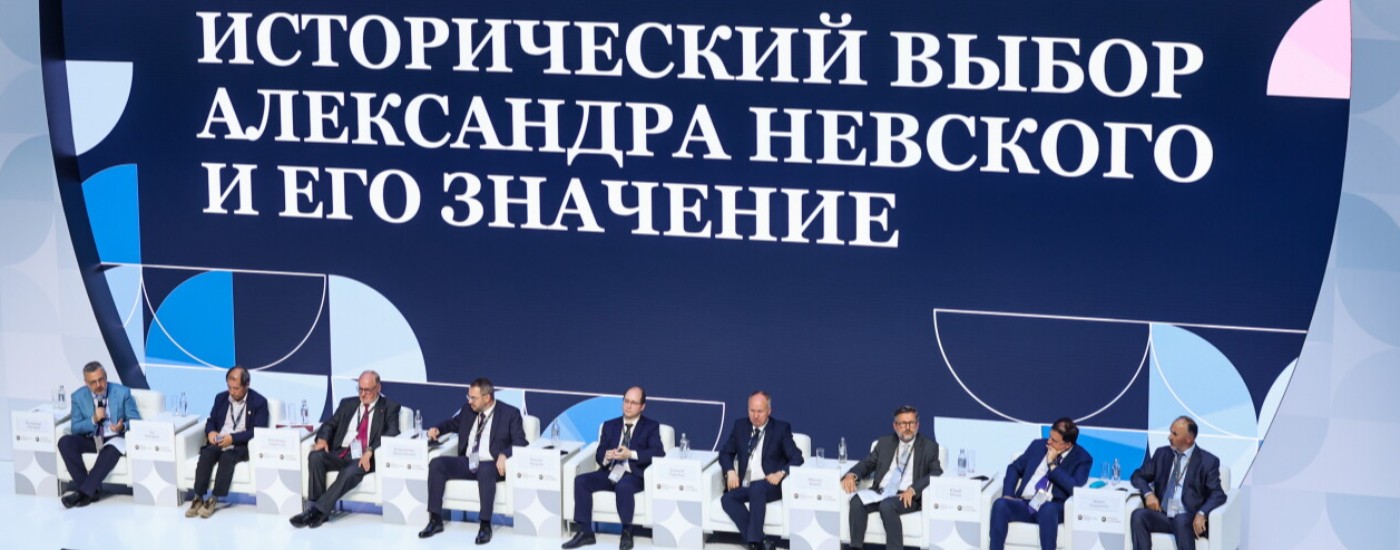
As part of the section Traditional Values as the Foundation of a Dialogue of Cultures at the XI St. Petersburg International United Cultures Forum, a panel discussion titled The Historical Choice of Alexander Nevsky and Its Significance was held. Participants discussed his role in Russia’s cultural and religious identity and the reasons why people turn to this figure at pivotal moments for the country.
Speakers talked about how to explain to young people the cultural and historical phenomenon of Alexander Nevsky and why it is important to rely on traditional values in a changing modern world. The session featured Deputy Minister of Science and Higher Education of the Russian Federation Konstantin Mogilevsky, Chairman of the Board of the Russian Historical Society Ruslan Gagkuev, Director General of the Boris Yeltsin Presidential Library Yuri Nosov, Professor at the Department of History of the Faculty of Philosophy of the University of Belgrade Milos Kovic, Director of the Institute of Historical Sciences at the University of East Sarajevo Draga Mastilovic, and a member of the jury of the Leo Tolstoy International Peace Prize Liu Wenfei, Director of the St. Petersburg Institute of History of the Russian Academy of Sciences Alexey Sirenov, and Director of the State Memorial Museum of A. V. Suvorov Vladimir Kirillov and Director of the Center for Humanitarian Studies of the Ministry of Culture of the Republic of Bashkortostan Marat Mardanov. The discussion was moderated by Vladimir Legoyda, Chairman of the Synodal Department for Church Relations with Society and the Media of the Moscow Patriarchate and a professor at MGIMO and Sirius University. He invited participants to address why the image of Alexander Nevsky becomes most relevant at turning points for the country and how important it is to establish a personal connection between modern individuals and figures of this stature.
"He achieved outstanding results in his relatively short life: he saved Russia and created the conditions for its further development. In my view, Alexander Nevsky the living man who lived in the 13th century, and Alexander Nevsky the saint who entered our historical memory as a holy image, are somewhat different Alexander Nevsky. We are dealing with a centuries-long history of veneration and glorification of Alexander Nevsky. In all difficult moments, of which there are many in Russia's history, people turned to the image of Alexander Nevsky. When Peter the Great built the northern capital, he chose Alexander Nevsky as its heavenly patron, emphasized Konstantin Mogilevsky.
Participants discussed how the image of Alexander Nevsky has become a symbol of uninterrupted continuity in the country's history, and the various forms it has taken over the centuries through its long history.
A good example is the presence, in every era of our country's development, of orders bearing the name of Alexander Nevsky. The first order appeared in the Russian Empire as early as 1725, introduced by Empress Catherine, and it existed for a very long time. A new stage in our country’s history began, and in the Soviet Union, precisely at a critical moment in our history, the Order of Alexander Nevsky appeared again. We see continuity embodied in a single figure across different stages of our development. Modern Russia also has the Order of Alexander Nevsky, and there is no other figure who has merited as much attention as this prince. Therefore, of course, we perceive him as a man who predetermined the development of our country for centuries ahead and made his choice when he saw the threat coming to Rus from the West. The historical memory of him has endured through the ages," noted Ruslan Gagkuev.
Liu Wenfei, a member of the jury of the Leo Tolstoy International Peace Prize, said that the figure of Alexander Nevsky is very well known in China, especially after the release of Sergei Eisenstein's film Alexander Nevsky in 1950. In his opinion, the image of the prince represents an eastern force in the conflict between Russia and the West. He also cited as an example a hero of China whom he compared to Alexander Nevsky – the general Yue Fei:
"They have much in common. First, both of them were invincible commanders who defended their country from invaders. Yue Fei began fighting powerful invaders at the age of 20 and over his lifetime took part in more than 100 battles. Even his enemies were forced to admit that it was hard to defeat his army. Second, they were not only military leaders but national heroes revered and respected by their descendants. Many Russian writers created novels about Alexander Nevsky. In difficult times Alexander Nevsky and Yue Fei were recalled more and more often, becoming symbols of independence; they were gods of war and national identity."
Foreign guests often mentioned during the discussion that their nations’ histories contain a figure similar to Alexander Nevsky. Milos Kovic was no exception; he compared the commander to the Serbian Prince Lazar Hrebeljanovic, speaking of their similarity at a deeper level:
“Saint Alexander Nevsky is highly venerated among Serbs and, you know, he is a very well known saint in Belgrade." For Serbs Saint Alexander Nevsky is very similar to Saint Prince Lazar, who fell at Kosovo in the 14th century. But, as is well known, Alexander Nevsky was victorious on Lake Peipus and on the Neva, whereas at Kosovo there was defeat. On the historical level Lazar suffered defeat, but on a deeper or higher level this was a psychological victory, because Lazar bequeathed to us a special traditional value known as the Kosovo Covenant. It is the same when Russians quote Alexander Nevsky: ‘God is in truth, not in might.’ What does that mean for Serbs? Every person should strive for the heavenly kingdom rather than the earthly one, for freedom rather than slavery, for truth rather than falsehood.