





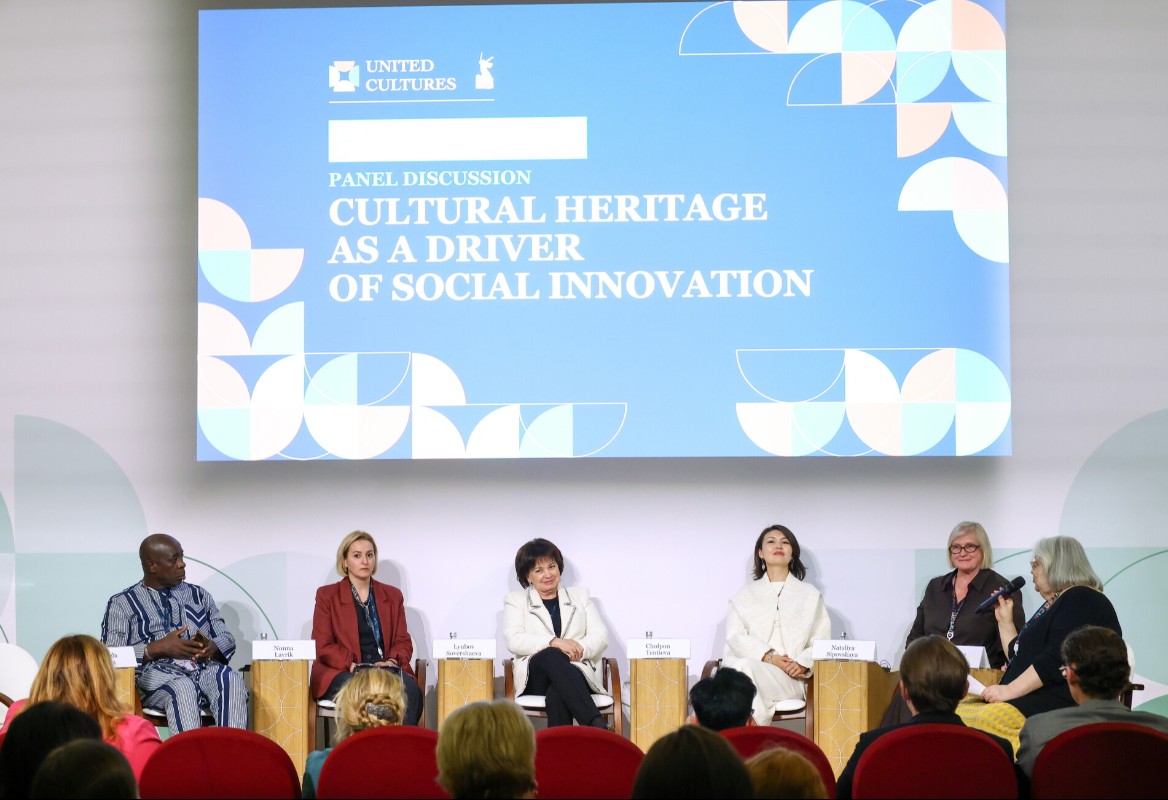
A panel discussion titled Cultural Heritage as a Driver of Social Innovation was held within the thematic session Cultural Heritage: Traditions and Modernity at the Lecture Hall of the Hermitage’s General Staff Building. The session was curated by Yulia Kupina, Director of the Russian Museum of Ethnography.
Participants included Lyubov Sovershaeva, Deputy Plenipotentiary Representative of the President of the Russian Federation in the Northwestern Federal District; Nona Lavrik, Minister of Culture and Archival Affairs of the Sakhalin Region; Natalya Sipovskaya, Director of the State Institute for Art Studies; Daouda Keita, Director of the National Museum of the Republic of Mali; and Cholpon Tentieva, expert on intangible cultural heritage and Director of the Center for Contemporary Art and Heritage Felting (Kyrgyz Republic). The discussion was moderated by Zorina Myskova, Chair of the Foundation Council and Director of the Hermitage 21st Century Foundation.
Speakers presented projects aimed at preserving cultural heritage and promoting it both in Russia’s regions and abroad.
Lyubov Sovershaeva presented the historical, cultural, and tourism project The Silver Necklace of Russia, created by presidential directive to unite the cultural heritage sites of the Northwest. The project’s uniqueness lies in its coverage of 11 constituent entities of the Northwestern Federal District and more than 10 subprojects, including a fairy tale laboratory, museums, and guidebooks.
“For us it is a Silver Necklace because the old wooden churches, the domes, the snow and often the sky itself gleam with silver. We have little sun and little blue sky. And silver is exactly a necklace, the pearls that the Northwest possesses,” explained Lyubov Sovershaeva, Deputy Plenipotentiary Representative of the President of the Russian Federation in the Northwestern Federal District.
Each year the project designates a new capital, which hosts major cultural events and promotes the city as a key cultural center of the region. Past capitals have included Staraya Ladoga, Ust-Tsilma, Solvychegodsk, Staraya Russa, and this year Tikhvin.
Sovershaeva also stressed that the most important factor in preserving cultural heritage is engaging local residents, and doing so in a way that makes them understand that preservation, promotion, and enrichment of our common heritage depend on them.
Speaking about her projects, which include the creation of a museum reserve, a patriotic route, and a reenactment of combat operations from 80 years ago, Nona Lavrik, Minister of Culture and Archival Affairs of the Sakhalin Region, focused on the 80th anniversary of victory over Japan and the formative role of cultural heritage:
“Today Sakhalin is a rapidly developing market. Culture has made a huge leap forward in the last three to four years thanks to the support of our governor. As he said, culture is something that can transform under any conditions and still deliver results. If not for the feat of our ancestors, none of this would exist now. Our main task is therefore to preserve this historical memory with care, to highlight properly what we have done, and to speak about what we will do.”
Summing up the discussion, Zorina Myskova noted that cultural projects are drivers of our attention.
“We discover new territories and new people. I believe people are our greatest treasure. Capitals of culture and points of cultural revival are everywhere people are. We already live in a multicultural world. And the full diversity of Russian culture is now visible thanks to these activities and these remarkable initiatives.”