





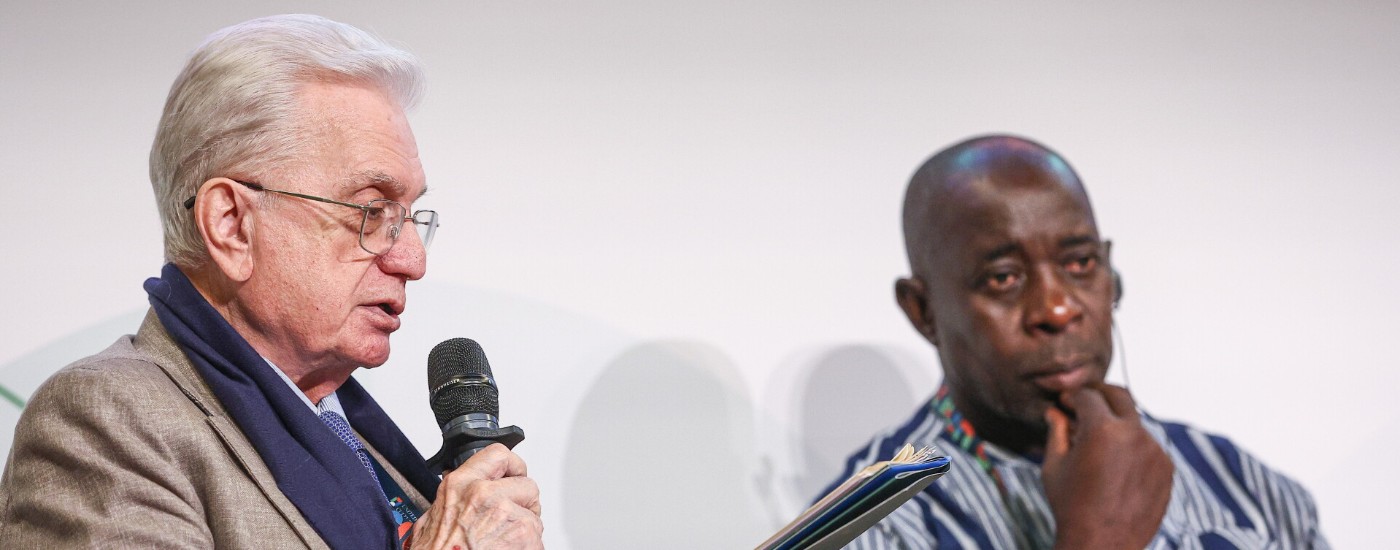
At the Forum, within the Museums section, an expert discussion titled “Sharp Edges of the Museum Space” took place. Participants explored the issues of appropriation and restitution of cultural property, as well as the legal and ethical aspects of its protection.
Speakers addressed the challenges faced by museums and states in safeguarding heritage sites in areas of hostilities, and the role of civic initiatives and digital technologies in preservation. The discussion was moderated by Mikhail Piotrovsky, Director General of the State Hermitage Museum. The panel included Daouda Keita, Director of the National Museum of the Republic of Mali; Victoria Karslieva, Executive Director of the E. M. Primakov Center for Foreign Policy Cooperation; Natalia Solovyova, Director of the Center for Rescue Archaeology at the Institute for the History of Material Culture of the Russian Academy of Sciences and Deputy Director of the Institute; Amir Kabiri, President of the Hermitage Israel Foundation; and Nurlan Dukenbayev, Director of the National Historical and Cultural Museum-Reserve (Kazakhstan).
Speaking about the role of digital technologies in safeguarding cultural heritage, Natalia Solovyova, Director of the Center for Rescue Archaeology at the Institute for the History of Material Culture of the Russian Academy of Sciences and the Institute’s Deputy Director, noted:
“First and foremost it is important to collect, align, compare, and provide the global community with objective data, and this is exactly what digital technologies allow us to do. It is especially important now, because absolutely all heritage sites carry some element of risk. The threats are diverse: natural disasters such as the earthquakes in Turkey and Syria, economic development of territories, armed conflicts, terrorism, and catastrophes. Today, in the Middle East and North Africa alone, more than 211,000 sites are at risk. Unfortunately, in the 21st century the deliberate destruction of sites happens most often. To erase a monument is to erase memory. The guarantor of memory is not its physical preservation but digital documentation, which cannot be rewritten or destroyed.”
Discussing the preservation of cultural objects in Timbuktu, Daouda Keita, Director of the National Museum of the Republic of Mali, spoke about the process of restoring and returning historical manuscripts and highlighted successful cooperation with partners in countries from which relics cannot currently be removed due to insufficient legal proof of ownership:
“When the Islamists were driven out of Timbuktu, we had to restore what had been destroyed, so the manuscripts were kept in Bamako for a long time, and they were digitized. To date we have digitized more than 300,000 manuscript documents, after which they were transported to Timbuktu last month. Some are still being digitized. Within our institution we have made significant progress with some partners, for example France, where we worked on 1,600 cultural heritage objects of the Republic of Mali.”
At the end of the discussion, Mikhail Piotrovsky invited participants to answer who should protect cultural heritage and how. Victoria Karslieva, Executive Director of the E. M. Primakov Center for Foreign Policy Cooperation, voiced hope that conflict discourse will diminish in the future:
“We have a very large block of work with specialists in international relations and political science, so we continue to do everything we can to form a young community of our future politicians and diplomats from around the world who, I hope, will build communication between each other in such a way that the work and discussions on restoration become fewer or cease altogether. I believe the conflict discourse should diminish, and if we have specialists in diplomacy and international relations who strive to resolve diplomatic conflicts, then I hope museums will focus on programs of education and the enrichment of collections.”